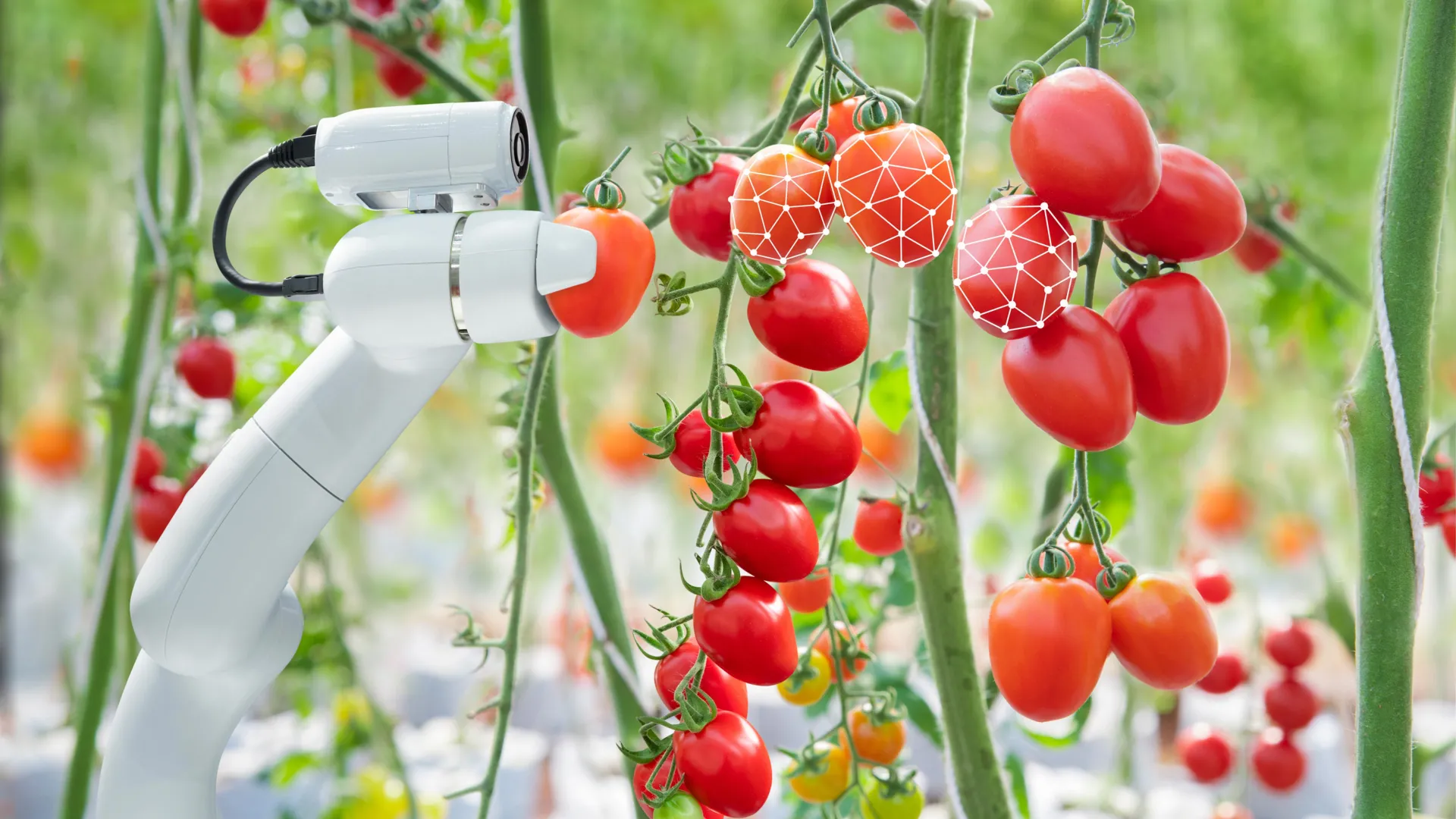
Field robotics has a new KPI: harvest ease. Osaka Metropolitan University just detailed a tomato-picking system that teaches a manipulator to predict how difficult each fruit will be before it makes a move. Instead of blindly grabbing whatever its camera sees, the robot weighs occlusion, stem angles, and cluster geometry, then chooses the approach vector with the highest likelihood of success.
What the researchers built
Assistant Professor Takuya Fujinaga’s team trained a vision model to do more than classify fruit. Their pipeline:
- Capture RGB images of tomato clusters, including stems, leaves, and any occlusions.
- Estimate a “harvest-ease” score for each fruit by analyzing how exposed it is and how tangled the stem looks.
- Select a primary pick angle; if the first attempt fails, replan from a lateral approach using the same scoring model.
The result: an 81% pick success rate, with roughly 25% of those successes coming from second-chance side grabs. That matters because most harvest failures in greenhouses stem from poor approach selection, not sensor noise. By encoding difficulty up front, the robot spends less time fighting stems it was never going to win against.
Inside the “harvest-ease” loop
Instead of labeling fruit as simply “ripe” or “not ripe,” the system classifies the surrounding scene. Stems that bend toward the robot get a higher score than stems that curl away. Leaves that block the calyx subtract confidence. Even the distance between neighboring tomatoes matters, because tight clusters leave no room for an end effector. All of those cues roll into a logistic model that outputs a single probability: if it’s above threshold, the robot commits.
When the first attempt fails, the robot doesn’t retreat—it re-evaluates the scene, shifts to a lateral posture, and attacks from the side. That second look is why one-quarter of successful picks happened after an initial miss. For growers, the nuance is huge: the robot adapts the way an experienced picker would, rather than cycling blindly through motions.
Why growers should care
- Labor math. Clusters force humans to slow down or risk bruising. A robot that self-selects “easy wins” lets crews focus on the stubborn fruit, stretching limited labor further.
- Higher-duty-cycle bots. By judging difficulty up front, the manipulator avoids wasting time on low-probability picks, which bumps throughput without faster hardware.
- Data for mixed fleets. Harvest-ease scores can feed into farm-management software, telling supervisors where to dispatch humans versus robots each shift.
Importantly, Fujinaga frames the system as collaborative, not replacement. Robots clear the low-hanging fruit automatically; humans handle the knotted stems and visually tricky clusters. That division of labor is how automation becomes palatable to growers who worry about quality control.
How I’d put this to work
The research gives ag-robot teams a playbook:
- Add difficulty scoring to perception. Don’t stop at detection; teach models to flag when depth, occlusion, or stem geometry will ruin the pick.
- Plan multi-angle attempts. Encode a fallback path (front, then side) so the arm doesn’t fully reset after a miss.
- Split duties. Let robots clear the “harvest-easy” queue autonomously overnight while human crews handle the tricky clusters during the day.
- Instrument for learning. Log every ease score, approach vector, and outcome so you can retrain on real-world misses and push OTA updates to the fleet.
Think of it as triage for crops. The system doesn’t need to solve every tomato; it just needs to know which ones are worth its time. That mindset also translates to other delicate crops—peppers, strawberries, even table grapes—where contact quality matters as much as speed.
What to watch next
- Adoption of harvest-ease metrics in other crops and by commercial greenhouse OEMs.
- Vendors bundling these models into retrofit kits for existing manipulators so farmers don’t need a brand-new robot.
- Labor contracts that codify how robots and people share rows, using quantitative difficulty scores to assign shifts.
- Insurance providers recognizing ease-scored logs as proof of gentle handling, lowering premiums for automated houses.
We’re edging toward the collaborative farm Fujinaga envisions: robots strip the easy fruit, humans tackle the puzzle pieces, and everybody gets better data about what’s left. Harvest-ease scoring turns greenhouse automation from a brute-force science project into an operations tool the whole crew can trust.
Source: “AI-powered robot learns how to harvest tomatoes more efficiently,” ScienceDaily, March 18, 2026.
