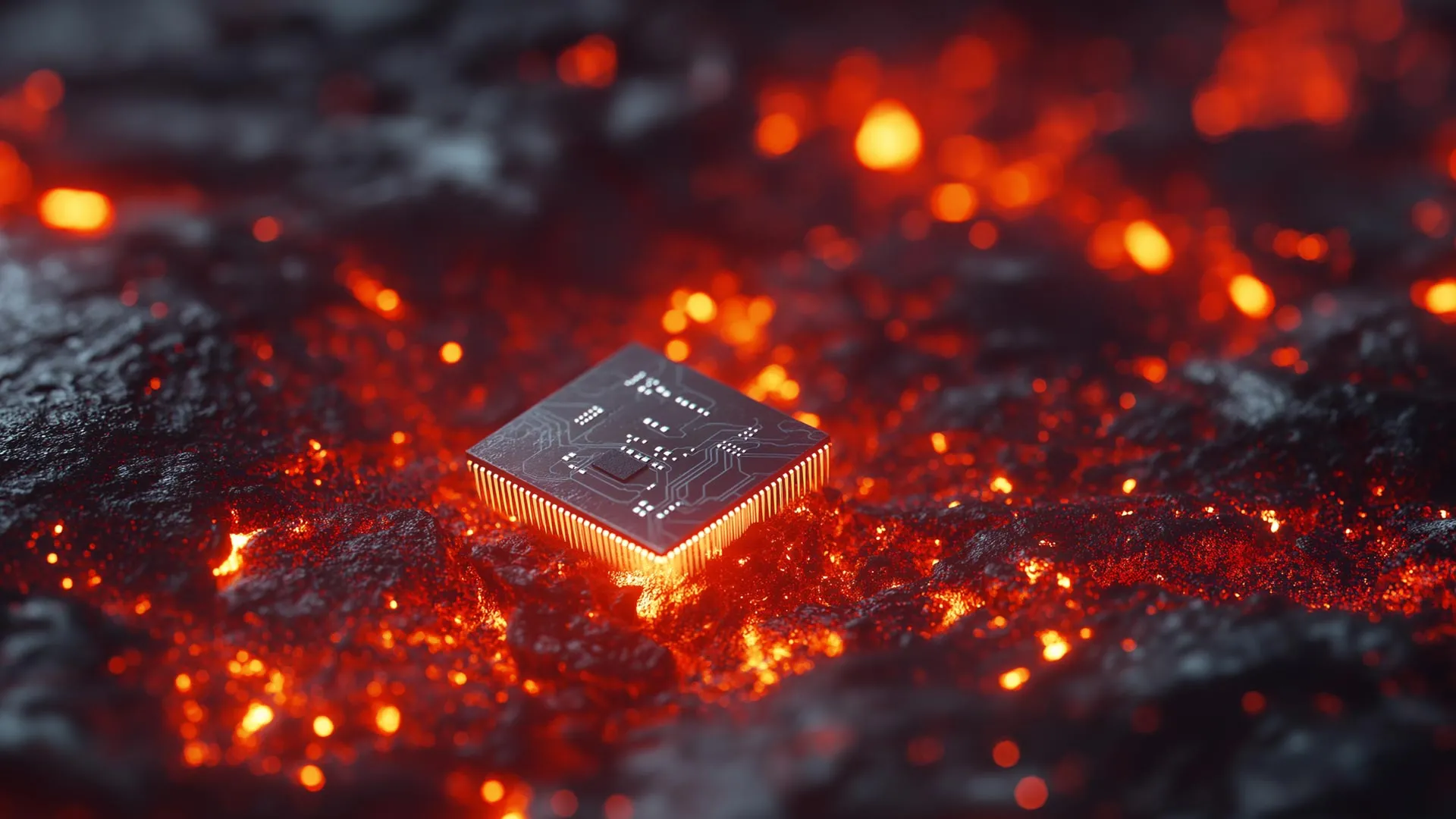
A memory chip just shrugged off 700°C. USC engineers built a tungsten–hafnium oxide–graphene memristor that kept switching after more than a billion cycles at 1300°F—hotter than molten lava. The device stored data for 50+ hours with no refresh, ran on only 1.5 V, and switched in tens of nanoseconds.
Why it works
- Tungsten top electrode: highest melting point of any metal.
- Hafnium oxide layer: a ceramic already used in CMOS fabs.
- Graphene bottom layer: acts like Teflon for tungsten ions—nothing sticks, so the device never shorts even when atoms start wandering at extreme heat.
The team stumbled on the design while chasing a different graphene device. Electron microscopy and quantum simulations later showed why the stack is so stable: tungsten atoms simply can’t wet the graphene surface, preventing conductive filaments from forming.
Performance snapshot
| Metric | Result |
|---|---|
| Max tested temperature | 700 °C (equipment limit) |
| Data retention at 700 °C | >50 hours |
| Switching endurance | 1+ billion cycles |
| Operating voltage | 1.5 V |
| Switching speed | Tens of nanoseconds |
Why robotics & AI teams should care
- Edge AI in hellish environments. Venus landers, geothermal drills, nuclear inspection bots, or fusion diagnostics can run compute right where data is generated instead of piping signals to fragile electronics miles away.
- Memristor math. These devices compute matrix multiplies passively via Ohm’s law (V×G=I). More than 90% of modern AI workloads are matrix multiplies, so memristor arrays promise orders-of-magnitude gains in speed and energy efficiency.
- Rugged everyday electronics. A chip rated for 700°C will laugh at the 125°C spikes inside autonomous vehicles or factory controllers, slashing failure rates.
Use cases to watch
- High-temperature exploratory missions. Future Venus probes or lava tube crawlers could execute onboard machine vision instead of waiting minutes for Earth commands.
- Geothermal monitoring. Downhole tools could analyze seismic data in place, reducing bandwidth requirements for remote sites.
- Hazardous manufacturing. Steel mills, furnaces, and refineries could embed intelligence inside zones currently off-limits to silicon electronics.
From lab to field
The prototype came from USC’s CONCRETE Center with Air Force support. It’s still hand-built, and logic circuits that can survive similar temperatures must follow. But two of the key materials—tungsten and hafnium oxide—are standard in today’s fabs, while wafer-scale graphene is already on Samsung and TSMC roadmaps. Translation: this isn’t sci-fi.
Joshua Yang and several co-authors already founded TetraMem to commercialize room-temperature memristor AI accelerators. Extending that roadmap to high-temperature stacks means a single architecture could eventually span data centers, cars, and Venus rovers.
What to do now
- Update your parts roadmap. Flag control units operating in hot zones (under-hood ECUs, furnace robots, reactor sensors) and mark where high-temp compute would unlock autonomy.
- Prototype hybrid boards. Design PCBs that mix conventional silicon and swappable accelerator sockets so you can slot in memristor modules once they’re available.
- Invest in digital twins. Simulate thermal, mechanical, and radiation loads today so you can validate next-gen chips quickly when they ship.
Challenges ahead
- High-temp logic. Memory is one block; controllers and interconnects must survive the same heat to build full systems.
- Packaging. Traditional substrates and solders will fail long before 700 °C, so new ceramics and interposers are needed.
- Manufacturing scale. Graphene integration is maturing but not yet mainstream; fabs will need new tooling to stack these layers at volume.
Checklist for robotics leads
- Map the “no-go” zones in your fleet where electronics melt today.
- Define what autonomy or sensing you would deploy if compute survived those zones.
- Start conversations with suppliers (or TetraMem-style startups) about pilot programs so you’re first in line when evaluation samples appear.
Yang sums it up: “Space exploration has never been so real, so close, and at such a large scale. This paper represents a critical leap into a much larger, more exciting frontier.”
The punchline: the last missing block for computation inside furnaces, reactors, and alien atmospheres is now on the table. If your roadmap includes extreme-environment autonomy, start planning as though the hardware is inevitable—because it just became technically possible.
Source: “This new chip survives 1300°F (700°C) and could change AI forever,” ScienceDaily, April 6, 2026.
