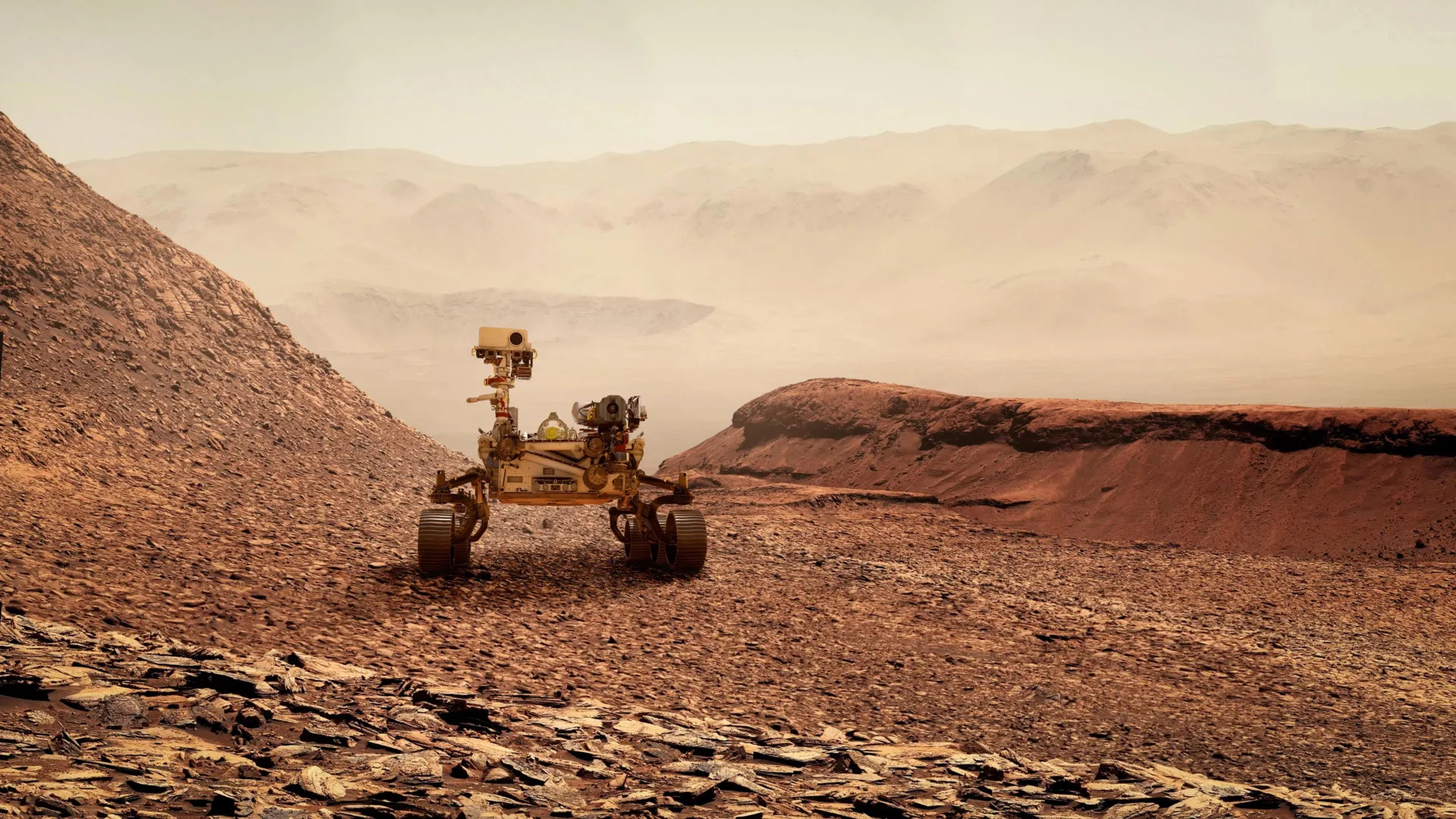
Perseverance just handed the steering wheel to generative AI. During sols 1707 and 1709 (Dec. 8 and 10, 2025), NASA let a vision-language model pick every waypoint for the rover’s route across Jezero Crater—the first time a drive on another planet was planned end-to-end by AI instead of human rover drivers.
How the experiment worked
- Engineers fed the model the same inputs human planners use: HiRISE orbital imagery, slope maps, and surface annotations from Perseverance’s telemetry archive.
- The AI analyzed hazards—bedrock, outcrops, ripple fields, boulder clusters—and generated a continuous path with ordered waypoints.
- Before uplinking commands, the team ran the plan through JPL’s digital twin, simulating 500,000 telemetry variables to ensure compatibility with Perseverance’s flight software.
The rover then executed two AI-planned traverses: 689 feet (210 meters) on the first day and 807 feet (246 meters) two sols later.
Why NASA cares
Distance kills real-time control. Mars is ~140 million miles away on average, so human drivers spend hours scrutinizing terrain and plotting 100-meter segments. Autonomous planning frees those teams to focus on science while enabling longer drives that still honor safety margins. It’s also a blueprint for Artemis surface assets and future Mars crews, where latency and workload will be punishing.
Inside the control stack
The demonstration used a vision-language model (built with Anthropic’s Claude stack) trained to link textual reasoning with visual cues. It effectively handled three tasks:
- Perception: labeling terrain classes from orbital imagery and rover thumbnails.
- Localization: stitching those labels into a map aligned with Perseverance’s current pose.
- Planning: emitting an ordered list of drive targets with confidence scores.
Humans remained in the loop. Engineers inspected the proposed route, the digital-twin results, and the command sequences before uplink. The AI augments, it doesn’t replace, the navigation team.
Operational lessons
- Digital twins are non-negotiable. Verifying the AI plan against a physics-accurate clone of the rover prevented command surprises.
- Confidence scoring matters. The model tagged each waypoint with risk levels so operators could adjust margins.
- Telemetry hygiene pays off. Years of well-labeled drive data made it possible to train and validate the planner quickly.
What this unlocks
- Longer daily drives. Kilometer-scale traverses become attainable without exhausting operators.
- Event-driven autonomy. AI can flag interesting geology mid-drive, letting scientists reprioritize targets faster.
- Edge intelligence. The same models could eventually run onboard rovers, helicopters, or lunar logistics wagons trained on the collective experience of NASA drivers.
Risk mitigation
NASA treated the demo like any flight-critical change: incremental rollouts, shadow-mode comparisons, and rollback plans. The AI plan was uplinked only after the digital twin and safety reviews cleared it, and operators monitored every meter via telemetry. That template—AI proposes, humans dispose—will guide future deployments.
Why it matters for robotics teams on Earth
If you’re building autonomous fleets, this is a case study in safely blending generative models with legacy control stacks. The ingredients translate directly: high-fidelity simulators, structured data archives, interpretable confidence metrics, and clear human override paths. The mission showed you can harvest institutional knowledge (decades of rover driving) and bottleneck it into an assistive model without handing over the keys blindly.
Implications for Artemis and Mars crews
Future astronauts won’t have time to hand-script every traverse. NASA envisions surface networks where rovers, cargo haulers, and even EVA suits share AI route planners trained on missions like Perseverance. The same tooling can prioritize science stops, avoid high-slope regions, and keep assets within comms range autonomously, freeing crews to focus on exploration instead of micromanaging logistics.
Data infrastructure takeaway
None of this works without disciplined data management. The team relied on years of tagged images, slope maps, and telemetry stored in accessible formats. If your organization wants similar autonomy boosts, start organizing drive logs, labeling hazards, and building digital twins now—the AI payoff comes only after that groundwork.
What’s next
JPL’s Exploration Systems Office is pushing toward “perception-to-plan” stacks that live across the mission: cloud-based planners that ingest new imagery, onboard inference that reacts in real time, and verification pipelines that prove the AI followed the rules. Expect similar trials on Ingenuity’s successors, upcoming lunar rovers, logistics convoys, and even crewed surface suits.
Source: “NASA’s Perseverance rover completes the first AI-planned drive on Mars,” ScienceDaily, Jan. 31, 2026.
