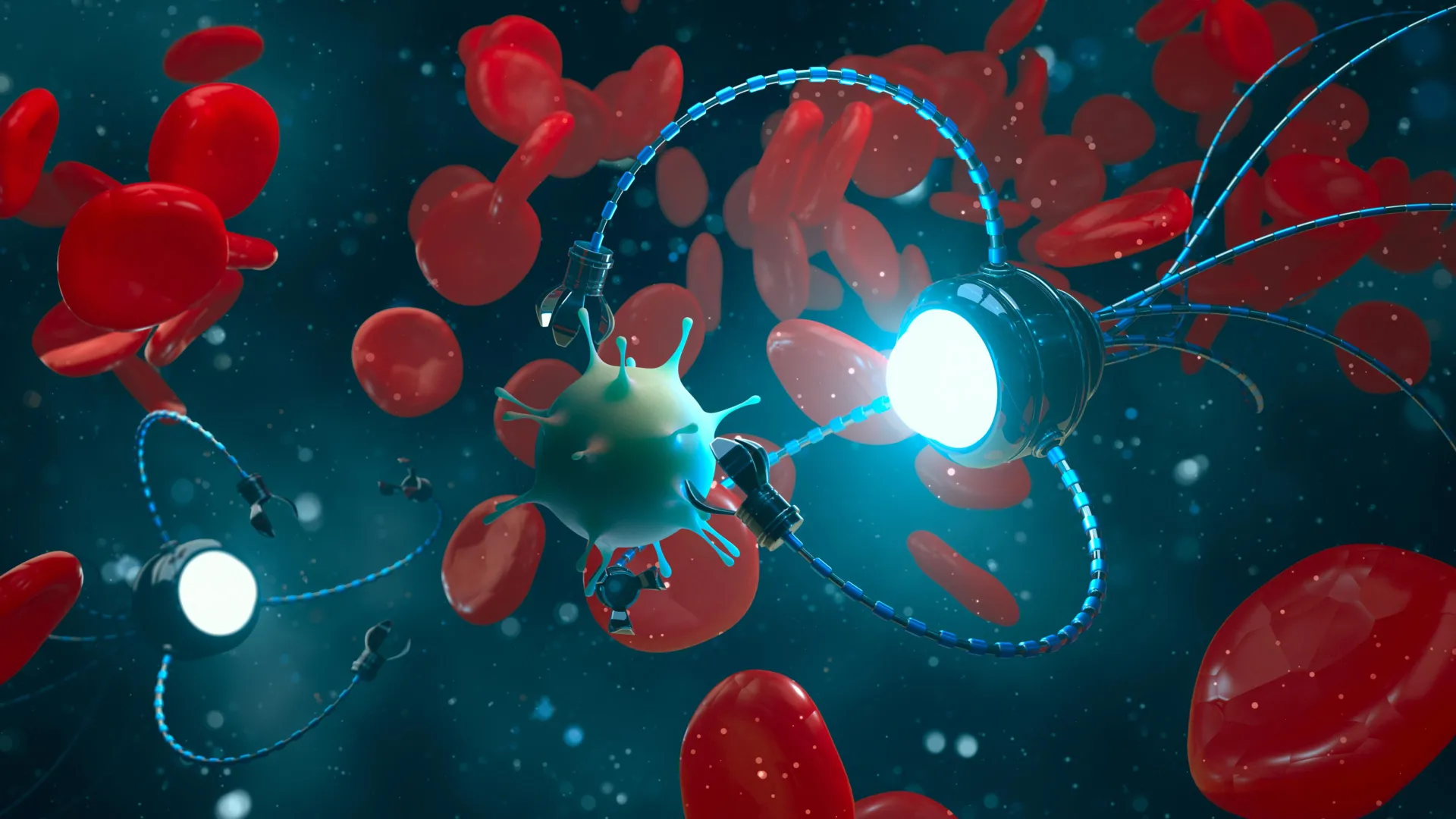
Robotics is shrinking from centimeters to nanometers. A new review highlighted by ScienceDaily shows researchers borrowing playbooks from macro-scale robots—rigid linkages, compliant joints, origami folds—and reimagining them with DNA strands. The goal: build programmable machines that can navigate a bloodstream, target a virus, or assemble sub-nanometer devices the way factory robots weld chassis.
Mechanics at the molecular edge
DNA provides both structure and instruction. By folding strands into rigid beams, hinges, and springs, engineers construct manipulators tens of nanometers wide that still behave like articulated arms. The control layer taps DNA strand displacement: carefully designed “fuel” strands dislodge structural strands to trigger a motion sequence. Think of it as swapping batteries to power a hinge, only the batteries are other DNA fragments.
External cues add another control axis. Electric or magnetic fields can orient an army of DNA bots simultaneously, while light pulses activate photoreactive segments that open or close gates. Those hybrids—chemical brains with physical tethers—are what transform static origami into mobile agents.
From lab demos to clinical payloads
The clearest short-term play is drug delivery. Instead of saturating the body with chemotherapy, nanosurgeons could recognize biomarkers on tumor cells, dock, and release a payload locally. Researchers are already exploring virus traps: DNA cages designed to present decoy receptors that bind pathogens such as SARS‑CoV‑2, locking them down until the immune system finishes the job.
Because these machines are built from biological material, they’re biodegradable, tunable, and less likely to trigger immune rejection than metallic nanoparticles. Pair them with fluorescent readouts, and they double as sensor networks that only light up when two biomarkers appear together—a logic gate for diagnostics.
Manufacturing in the molecular world
DNA robots also moonlight as programmable fixtures. They can position nanoparticles with sub-nanometer accuracy, laying out photonic circuits or quantum dots like pick-and-place machines on a silicon wafer. Acting as self-assembling templates, they could produce optical devices with efficiencies today’s lithography can’t touch, or build molecular memory arrays that organize themselves.
Toolchains still missing
- Brownian chaos. At nanoscale, thermal noise thrashes structures in random directions. Control algorithms must embrace probability, not pretend the environment is deterministic.
- Primitive design kits. Macro roboticists enjoy CAD libraries of servos and sensors. DNA engineers still lack standardized parts lists or accurate simulators for mechanical properties.
- Longevity. DNases shred constructs in vivo. Shielding strategies—chemical caps, protective coatings, or hybrid materials—need to mature.
- Swarm coordination. Most prototypes operate solo in ideal buffers. Real use cases will demand fleets that cooperate, avoid collisions, and split tasks.
What needs to happen next
Researchers outline several concrete steps:
- Parts libraries. Document stiffness, hinge range, and actuation speed of common DNA motifs so designers can assemble robots like LEGO kits.
- AI-assisted design. Use generative models to explore fold patterns and control circuits that human intuition might miss, then validate with high-throughput simulations.
- Bio-manufacturing pipelines. Scale synthesis and purification methods so thousands of identical nanorobots roll off assembly lines with quality assurance, akin to semiconductor fabs.
- Hybrid control. Combine biochemical logic with external fields so bots can respond to both local molecular cues and top-down “traffic signals.”
Regulatory and ethics preview
The first approvals will likely mirror gene therapies: tightly controlled compassionate-use cases, heavy pharmacovigilance, and bespoke manufacturing per patient. Robotics leaders should expect to document not only what a DNA bot does, but how it proves it followed the script—think molecular-level black boxes. That means logging which strand displacement events fired, which external signals were applied, and how the device biodegraded. Building that compliance layer now will prevent delays once regulators catch up.
Why this matters for robotics teams
If you already work on autonomy, perception, or planning, DNA robots are another domain where your skill set translates. Path planning becomes probabilistic navigation through viscous media. Manipulation turns into strand displacement choreography. Safety becomes biocompatibility. Teams that bridge wet labs and robotics toolchains can own this new stack.
The payoff is staggering: programmable, biodegradable machines that extend robotics into biology and materials science. As the authors noted, “the robots of tomorrow won’t just be made of metal and plastic—they will be biological, programmable, and intelligent.”
Source: “DNA robots could deliver drugs and hunt viruses inside your body,” ScienceDaily, March 31, 2026.
